The straight answer
The average author sells about 250 copies, and 90% of authors never reach 5,000. Those numbers are your starting pistol. Track the metrics that actually matter, like whether your first 100 readers turn into advocates, and treat your book like a business asset if you want to beat them.
Real book sales benchmarks matter — but only so you know exactly which ones you’re about to break.
Let’s stop pretending you wrote your book just to tell your Mom you did.
You wrote it to move people.
To make noise.
To create legacy, leverage, and income that actually matter.
So why are you still chasing “average”?
The average author sells 250 copies.
The average traditionally published title sells 3,000.
The average isn’t your finish line.
It’s your starting pistol.
You’re not here to be average. You’re here to swing the curve.
The Baseline Reality (So You Know What You’re Beating)
Before we break the system, let’s see the system:
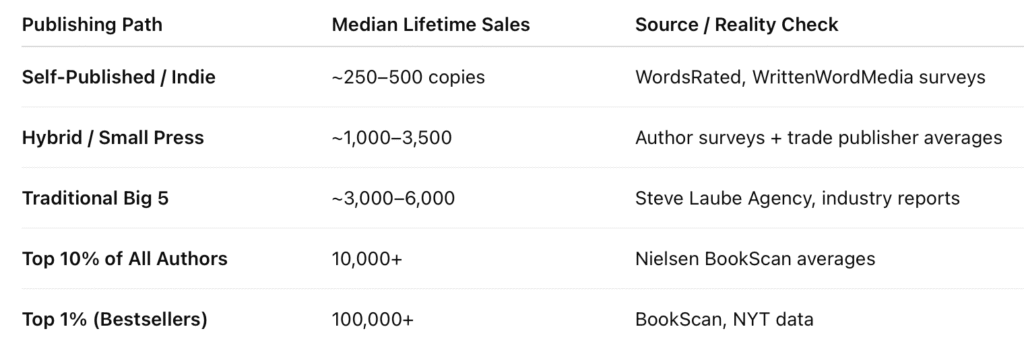
📍 Translation: 90% of authors never hit 5,000 copies.
📍 Truth: That’s because 90% of authors never treat their book like a business asset.
Real Benchmarks — By Genre
These are your “known baselines.”
Tattoo them on your mind. Then plan to outgrow them.
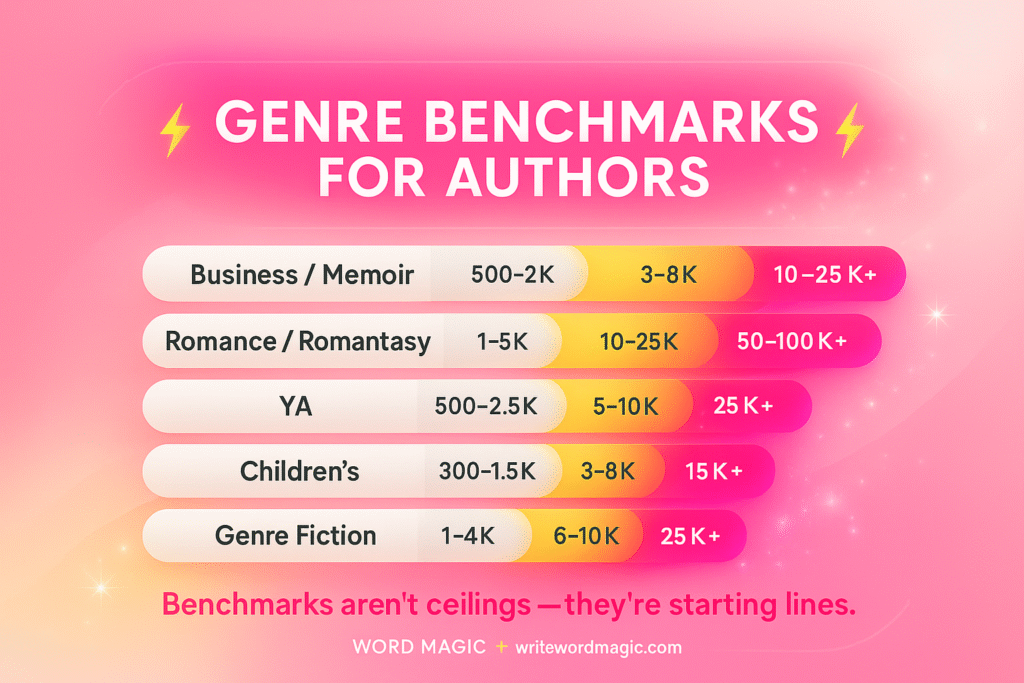
These aren’t ceilings. They’re checkpoints.
Your job isn’t to blend in — it’s to build beyond.
The 7 Metrics That Actually Matter
Forget “likes,” “follows,” and “vibes.”
If you want to steer your book like a CEO, track these instead:
Rule of thumb: if your first 100 readers turn into advocates, you’ve got a viral curve.
If they turn into crickets, you’ve got editing to do.
The Benchmark Ladder (Use This Like a Progress Map)
Every author needs something to climb.
Use this as your roadmap — not your ruler.
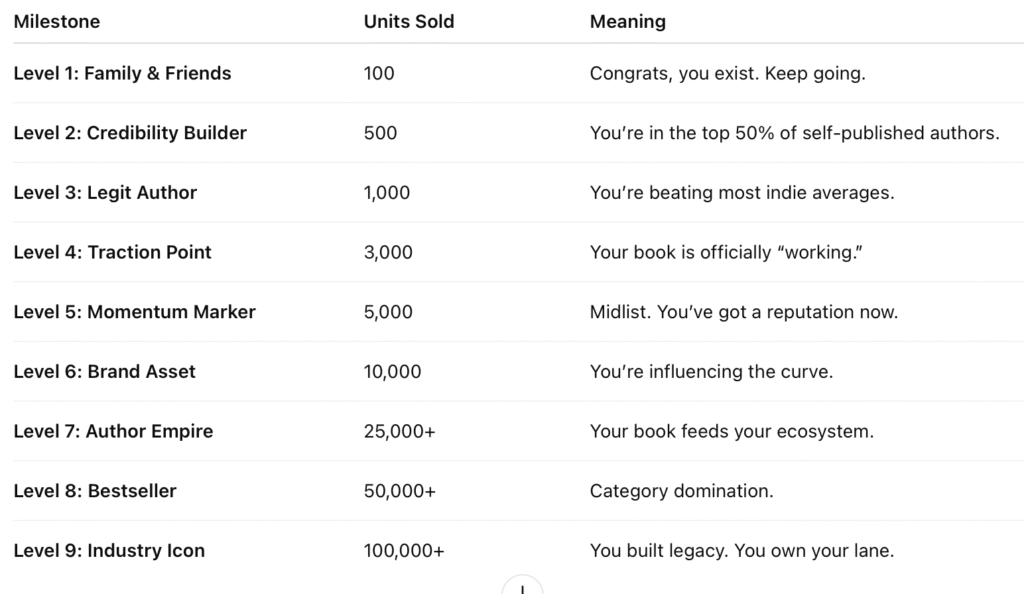
Your job isn’t to get to Level 9 once — it’s to build systems that make Level 5 your floor.
Benchmarks by Publishing Path
Each model gives different tools — and different ceilings. Know your lane.
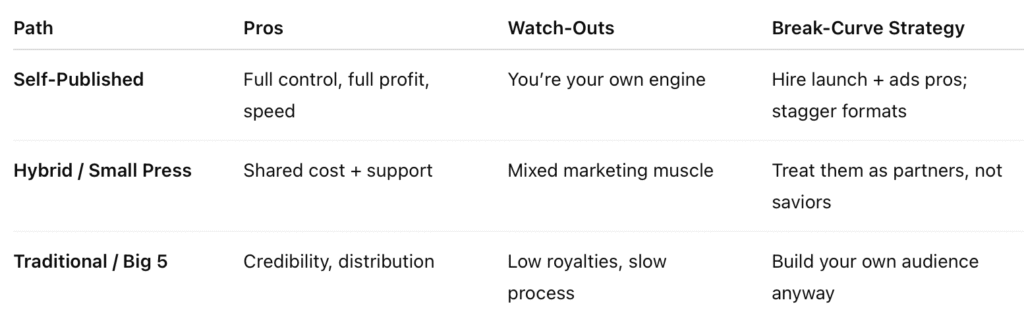
Most authors stop at “book launch.”
The ones who win treat their book like a product. They relaunch, repackage, and re-market every 6 months.
Genre Deep Dives (For the Stat Nerds Who Want to Sell)
Business / Nonfiction
- 2,000–6,000 lifetime copies = strong midlist
- 10,000+ = you’re in keynote speaker / high-fee territory
- 50,000+ = you’re getting inbound media + consulting on repeat
Play to win: Data-driven launch, lead magnets, podcast tour, speaking funnel.
Romance / Romantasy
- Romance owns 53% of all self-published ebook sales.
- Average romance author earns 3x the revenue of an indie in any other genre.
- Fast releases + series = exponential growth.
Play to win: Rapid release model, BookTok, reader groups, emotional hooks that make people scream into pillows.
Children’s + YA
- Kids’ books are evergreen: libraries, teachers, parents.
- YA sales grew 48% from 2018–2022.
- Breakout YA = 25,000+ copies and licensing rights.
Play to win: Think series. Think school partnerships. Think audiobook + merch.
Thriller / Horror / Genre Fiction
- Traditional fiction median: 4,000–8,000.
- Horror indie market exploded post-TikTok.
- 10,000+ = you’re brandable; 25,000+ = cult status.
Play to win: Niche communities + algorithm-based reader discovery.
Memoir
- Most non-celebrity memoirs: 1,000–5,000 lifetime.
- But memoirs have emotional endurance — long-tail resonance.
- One strong podcast, one viral essay, one documentary option = 10x curve.
Play to win: Authenticity + visibility + a hook that transcends “me.”
Stop Treating Benchmarks Like Beliefs
Benchmarks are data points, not prophecies.
They don’t decide your ceiling — your marketing, mindset, and message do.
Averages keep the industry safe.
But you didn’t write a safe book.
So here’s your new mantra:
“My book wasn’t meant to get in line — it was meant to redefine the damn line.”
If the average self-pub sells 500, aim for 5,000.
If trad midlist caps at 6,000, aim for 60,000.
And if someone tells you “that’s not realistic,” good.
You weren’t going for realistic.
You were going for remarkable.
Your Next Fave Read
- The Audiobook Opportunity Most Authors Are Leaving on the Table
- What Happens After You Write Your Book? The Launch Strategy Most Authors Miss
- How to Build Your Author Platform Before Your Book Is Written
Ready to get your wisdom into the world, however you write it? Book a free validation call. I’ll help you figure out the right approach for your specific book and your actual goals, whether that’s coaching, ghostwriting, or the two of us writing it together.