The straight answer
Start with a book worth talking about, then sell it like a founder launching a product. Aim for 1,000 copies in your first 100 days, because that’s what wakes up algorithms and media. Clean up your metadata, stagger your formats, and make 2 marketing moves a week for a full year. Fewer than 1% of books sell over 5,000 copies, and luck isn’t a marketing plan.
How to sell more books? It starts long before launch day, with a plan most authors never build.
Let’s talk about the quiet truth behind every author meltdown I’ve ever witnessed:
most books die on the vine.
How to Sell Tens of Thousands of Books: Proven Strategies
We romanticize writing as divine inspiration — lightning bolt, candlelight, maybe a crying muse in a cardigan. But publishing? That’s business. And if you want to play this game like a pro, you have to stop thinking like an artist begging for validation and start thinking like a founder launching a product that changes lives.
The Harsh Math Nobody Likes to Quote
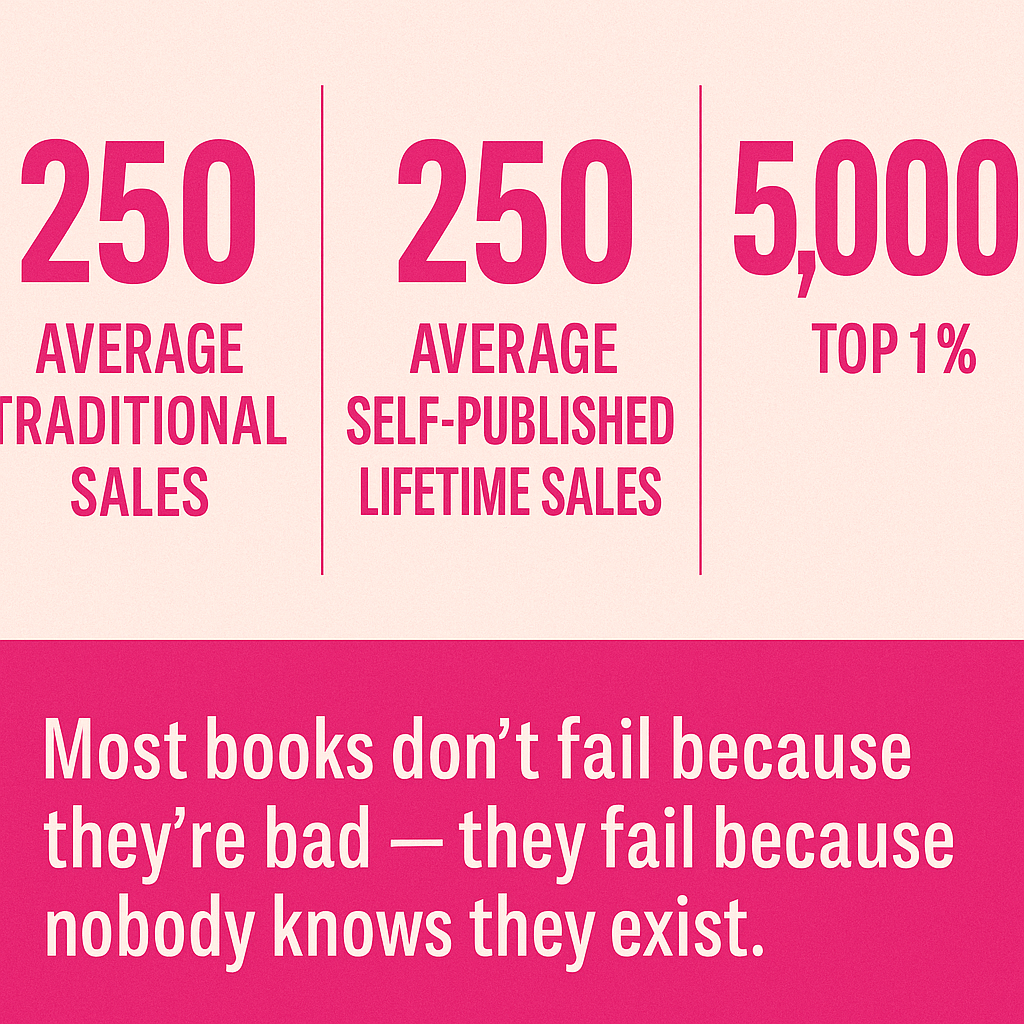
Average traditionally published book? Roughly 250–300 copies sold in its first year.
Average self-published book? 250 copies lifetime.
That’s not success — that’s a family reunion.
Less than 1% of books ever sell more than 5,000 copies. And yet those are the books people talk about, teach from, quote, and gift for years.
If you want to be in that 1%, stop hoping for luck. Hope is not a marketing plan.
Start with a Book Worth Talking About
No marketing trick in the world can fix a boring book.
Write something that makes people say, “You need to read this.”
That’s your baseline strategy — the rest is amplification.
The easiest way to know you’ve nailed it? Beta readers finish your draft and immediately text three people about it. If no one’s talking, you’ve got editing left to do.
A book that moves people is a marketing machine disguised as art.
Define Your One True Reader
If your reader avatar sounds like “women ages 25 to 45 who enjoy self-improvement,” congratulations — you’ve just described the entire internet.
Get specific.
Picture the human sitting in their car at 8:43 AM, dreading another day at a job they’ve outgrown. What are they Googling at night? What are they afraid to say out loud?
You’re not writing for everyone. You’re writing for that one person who feels seen when they read your words — and then tells everyone they know.
That’s how book empires begin. One super-fan at a time.
Know Your Energy Game
Authors fall into two categories:
- Launch Sprinters — adrenaline junkies who love countdowns, checklists, and the dopamine of day-one rankings.
- Slow-Burn Marathoners — strategic builders who thrive on compounding results month after month.
Both work. The only failure is pretending to be one when you’re actually the other.
Your marketing plan should match your metabolism.
The Pre-Launch Hustle: Seeding the Spark
If you drop your book on Amazon and “hope it takes off,” that’s not strategy. That’s astrology.
Start seeding early.
Give copies to people who can help you light fires — podcasters, community leaders, reviewers, influencers who already love your niche. Don’t just say “please share.” Make it worth their while. Feature them. Send a handwritten thank-you. Make them part of your story.
Your first 100 readers are gold. Treat them like an inner circle — not a mailing list. When they feel seen, they turn into evangelists. And evangelists move mountains.
Clean Your Metadata (Seriously)
Every successful author I know obsesses over three things most newbies ignore:
title clarity, cover design, and metadata.
If your title is clever but unclear, it dies.
If your cover doesn’t read in a one-inch thumbnail, it dies.
If your keywords and categories don’t match how readers actually search, it dies quietly in an algorithmic ditch.
It’s not sexy, but this is what separates books that get discovered from those that disappear.
The 1,000-in-100 Rule
Real talk: if you want to break out, aim to sell 1,000 copies in your first 100 days.
That’s the magic number that wakes up algorithms, piques media interest, and builds enough buzz to keep word-of-mouth rolling.
Miss that window and you’re climbing a steeper hill later.
The good news? You can do it with intention, not luck.
- Offer $4.99 e-book promos to spike downloads and rank.
- Use BookBub or Kindle Deals when possible — they’re rocket fuel if you time them right.
- Stack small, low-budget Amazon ads ($5–$10/day) to keep your book visible while you sleep.
That’s not vanity marketing. That’s data-driven positioning.
Forget the “Launch Week” Obsession
The internet made everyone think book success happens in 7 days.
It doesn’t.
The authors who last — the ones pulling real numbers — treat launch as the starting line.
Tim Grahl (who’s helped launch dozens of NYT bestsellers) calls it the 365/10,000 rule:
You work your launch for a full year — and you focus on getting 10,000 readers through your book. That’s when it sticks. That’s when it snowballs.
If you’re tired after week two, you’re doing it wrong.
Stagger Your Formats
Don’t blow your whole load on day one.
Start with your e-book, then paperback, then audiobook.
Each new release is another excuse to talk about your book — another news hook, another spike.
The secret weapon?
Bundle offers. Signed copies. Limited runs. Anniversary editions. Readers love a reason to re-engage. Give them one.
Stay Generous, Even When You’re Selling
I know — generosity sounds fluffy. But it’s a weapon.
Give away chapters, guides, bonuses, masterclasses.
Be so valuable they can’t ignore you.
Generosity doesn’t cheapen your book — it multiplies its reach.
Readers share what makes them look smart or inspired. If you give them that, they’ll do your marketing for you.
Two Marketing Moves a Week
That’s the rhythm. Two things, every week, for a year.
One might be a podcast interview.
One might be a viral post, a short video, a quote card, a newsletter, a mini-discount.
That’s over 100 micro-moves a year — each one a fresh spark.
The authors who treat their books like living organisms (not relics) are the ones who watch them grow.
Measure What Actually Matters
Not vanity metrics. Not follower counts.
The numbers that tell you the truth:
| METRIC | WHAT IT MEANS | HEALTHY RANGE |
| Early Sales (First 3 Months) | Momentum | 500-1000+ |
| Reviews | Social Proof | 50+ early |
| Email Opt-ins | Conversion | 2-5% of visitors |
| Monthly Sales After Launch | Staying Power | Flat or Rising |
| Cross-sell Revenue | Book -> business | 10-30% of income |
Those numbers don’t just measure sales — they measure reach.
Because the endgame isn’t just books sold. It’s opportunities gained.
A book that sells 5,000 copies and lands you one $50K consulting deal has done its job.
Case Studies That Prove It Works
Amanda Montell built lasting sales through storytelling, not just media hype. Her team stretched her promotion over a year, securing book clubs, essays, and podcast features. That’s longevity.
James Morehead, a poet, used micro-influencers, giveaways, and format staggering to make a poetry book profitable. Poetry. That’s supposed to be impossible.
Thousands of indie authors on Reddit report that the big breakthroughs happen months after launch — when enough reviews and traffic kick the algorithm into gear. Patience pays.
Hot Takes You Didn’t Ask For
- Lower your price if you need to. Volume wins over vanity pricing.
- Don’t obsess over a perfect funnel — obsess over perfect readers.
- Use algorithms, but don’t depend on them. You’re the driver, not the data.
- If your marketing feels icky, change your method, not your mission.
- Stop trying to go viral. Try to go valuable.
Your 12-Month Playbook
Months –6 to –3: Build your audience, share your ideas, line up early readers.
Months –2 to 0: Polish metadata, lock cover, gift ARCs, prep interviews.
Months 0–3: Blitz smartly. Hit that 1,000-copy benchmark.
Months 4–6: Launch new formats, run promos, nurture community.
Months 7–12: Keep momentum. Two moves a week. Add new hooks, fresh stories, and ways for readers to stay in your world.
After a year, you should have traction, revenue, and reputation.
And that reputation? It’s the real prize.
You didn’t pour your soul into a book so it could rot on a digital shelf.
You wrote it to be read. To reach. To ripple.
So sell it like it deserves to be seen.
Not timidly. Not apologetically.
Like it matters.
Because it does.
Your Next Fave Read
- The Audiobook Opportunity Most Authors Are Leaving on the Table
- What Happens After You Write Your Book? The Launch Strategy Most Authors Miss
- How to Build Your Author Platform Before Your Book Is Written
Ready to get your wisdom into the world, however you write it? Book a free validation call. I’ll help you figure out the right approach for your specific book and your actual goals, whether that’s coaching, ghostwriting, or the two of us writing it together.