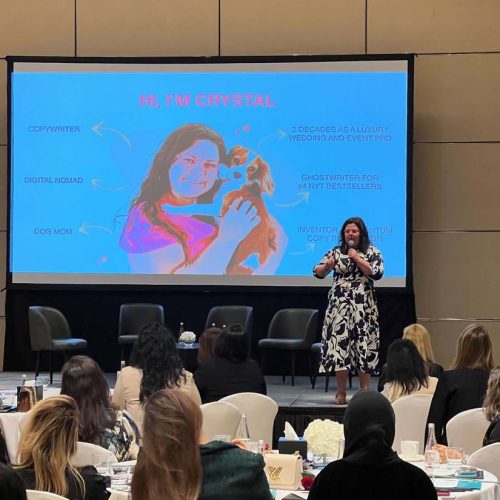
The worst brief I ever got was four words long.
“Just do your thing!”
Sent warmly, by a genuinely lovely organiser, three days out from a keynote to a room I knew nothing about. So I did my thing. My thing was fine. It was also aimed at roughly the wrong people, because “my thing” is a menu and nobody had told me what the room was hungry for.
That one’s on me as much as her. I should have pushed.
If you’re programming an event you are already doing the hardest job in the building, with a budget that got cut and a committee with opinions. So this isn’t a lecture. It’s the stuff I wish somebody had told me when I was on your side of the email. Nine countries, conference mainstages, association AGMs and one genuinely memorable room in Fiji later, here’s what actually moves the needle.
Almost all of it fits in one email.
A thin brief doesn’t get you a bad speaker
That would at least be memorable. What you get is duller and considerably more expensive.
Given nothing, a professional defaults to the talk that works in the widest possible number of rooms. It’s polished, it’s competent, it has been delivered ninety times. It is aimed at the average of all possible audiences, which means it’s aimed at nobody in particular, least of all the three hundred specific humans who took a day out of their lives to sit in front of it.
You didn’t book a bad speaker. You ordered the generic edition without realising it was on the menu, which is a bloody expensive way to buy average.
What to put in the email
Who’s genuinely in the room. Not the job titles from the registration form. Are these owners or employees? Did they pay themselves or did the company pay? Are they at the top of their field or clawing toward it? “200 members” tells me nothing. “About 60% agency owners, 40% their senior staff, and the owners are the ones who’ll ask questions” tells me how to pitch every single example I use.
Why they actually came. People attend events for reasons that have very little to do with the programme. CE credits. Seeing people they see once a year. Getting out of the office. Being seen at the thing. A room that’s there for the networking needs a completely different talk from a room that’s there to learn something specific, and your speaker cannot tell which is which from the stage until it’s far too late.
What’s happened to this group in the last twelve months. This is the one that separates a good brief from a great one and almost nobody sends it. Did the sector get hit by something? A merger, a scandal, new regulation, a wave of redundancies? Is everyone quietly terrified of something nobody’s naming out loud?
A speaker who knows can acknowledge the room’s real situation in the first ninety seconds and the entire talk lands differently. A speaker who doesn’t know will confidently say something tone-deaf and spend the rest of the session wondering why the energy died. I have been that speaker. It is a long forty minutes.
The running order. If the session before mine is a panel on the same subject, I need to know so I’m not the third person that morning explaining the same premise. If I’m on after lunch, tell me, because that room needs waking up and I’ll build it differently.
What you need to be true when they walk out. This is the actual brief and most organisers leave it out, because it feels like telling a professional how to do their job. It isn’t. It’s telling them what you’re for. Energised? Uncomfortable? Signing up for something in the foyer? Do you need the board to feel the money was well spent? Say it plainly. “I need them to leave thinking differently about X, and I need the sponsors to feel visible” is an enormously useful sentence and I have received it about four times in my entire career.
Then ask for three things
- Unedited footage. Not a showreel. A showreel proves somebody can afford an editor. Twenty unbroken minutes proves they can hold a room when nothing is being cut around them.
- What they need from the space. Lectern or handheld? Do they move? Questions in the room or afterwards? Ask early, because the answer sometimes changes the set.
- A reference from a similar room. Not their biggest booking. Their most similar one. Somebody who ran an event roughly like yours.
The bit that tells you everything
Send your brief. Then watch what comes back.
Someone who intends to do the work will ask you things like: what went wrong at the last one? Who in this room will disagree with me, and how loudly? What can I say that you can’t? What’s everyone thinking and nobody saying? Is there anything I should absolutely not touch?
Those last two matter enormously. An outside speaker can name the difficult thing in a way that nobody internal can, and a good one will go looking for that job on purpose. It’s frequently the entire reason to bring in an outsider at all.
If what comes back is “Sounds great, looking forward to it!”, well. There’s your answer. You’ve booked the generic edition. It’ll be fine. Fine is what you’ll get, and fine is what people forget on the drive home.
Three things that predict a dud
They won’t customise. Some speakers have one talk and sell it as seven. That’s not automatically a crime, a genuinely brilliant talk earns its repetition, but they should be honest that it’s fixed and you should know you’re buying a fixed thing.
They ask about the fee before they ask about the audience. Everyone needs to know the fee. I need to know the fee. It’s the order that tells you something.
They agree to everything. Propose a topic slightly outside what they do and watch. An instant yes is a warning. The good ones will tell you when you’ve asked for the wrong talk. I’ve turned down bookings because the room wanted something I’d have done adequately and somebody else would have done brilliantly, and I have never once regretted it.
The short version
Tell them who’s really in the room, why those people came, what’s happened to them this year, and what you need to be true when they leave. Ask for unbroken footage and one relevant reference. Then see whether they come back with questions.
Do that and you’ll get the version of the talk that was built for your room, which is the thing you were trying to buy in the first place. Four words will get you four words’ worth. That is just maths.
Your Next Fave Read
- How to Write a Book as a Keynote Speaker Without Losing Your Voice or Your Mind
- How to Build Your Author Platform Before Your Book Is Written
- The Storykeeper Manifesto: Why Your Most Powerful Business Asset Hasn’t Been Written Yet
Ready to get your wisdom into the world, however you write it? Book a free validation call. We’ll figure out the right approach for your specific book and your actual goals, whether that’s coaching, ghostwriting, or the two of us writing it together. writewordmagic.com