
Every week, I speak with authors who have spent months — sometimes years — asking the same question:
“So… how do I actually get this published?”
It’s a fair question. The publishing industry in 2025 is more complex — and more full of opportunity — than it’s ever been. There are genuinely good options across the spectrum. But there’s also a lot of noise, a lot of bad advice, and more than a few people willing to take your money before you know what you’re getting into.
This post is my attempt to give you the honest overview I wish more first-time authors had before they made a decision. Not a pitch. Not a sponsored breakdown. Just the real shape of each path, and what I’ve seen work (and not work) after more than a decade in this industry.
One number worth sitting with before we start: 97% of books that get started are never finished. Not because the writers weren’t talented. Because they didn’t have the structure, the accountability, or the right support. That’s not a writing problem. It’s a strategy problem.
Keep that in mind as you read. Publishing path matters — but getting the book written matters more.
The Three Main Publishing Paths (And What They Actually Mean)
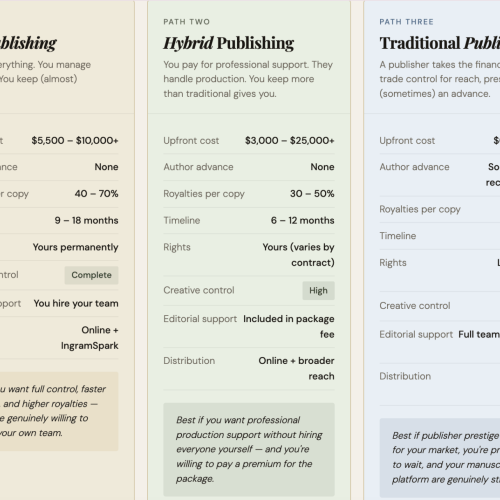
Let’s deal with the basics first. There are three main routes to getting a book published, and they differ fundamentally in who takes the financial risk, who controls the creative decisions, and who makes money — and how much.
Traditional Publishing
Traditional publishing is what most people picture when they imagine “getting published.” A literary agent represents you, pitches your manuscript to editors at publishing houses, and — if you’re fortunate — you sign a deal. The publisher pays for editing, design, printing, and distribution. In some cases, you receive an advance against future royalties.
Here’s what the numbers actually look like:
- Royalties: 8–15% per copy
- Upfront cost to you: $0
- Timeline from deal to bookshelf: 1–3 years
- Rights: licensed to the publisher
- Creative control: limited — title, cover, and content can all change
The prestige is real. The bookstore distribution is real. But so is the rejection rate (most debut authors receive dozens of rejections before signing — if they sign at all), the wait time, and the reality that most advances don’t earn out. For many business authors and thought leaders, waiting two to three years for a book that serves a commercial purpose makes very little strategic sense.
Hybrid Publishing
Hybrid publishing sits between traditional and self-publishing. You pay a company to handle the professional production of your book — editing, design, printing, distribution — while retaining more creative control and a higher royalty rate than traditional publishing would give you.
The numbers:
- Royalties: 30–50% per copy
- Upfront cost: $3,000–$25,000+
- Timeline: 6–12 months
- Rights: typically yours, but read every contract carefully
- Creative control: high
A word of caution: this is the path with the most bad actors. Some companies call themselves “hybrid” when they are, in practice, vanity publishers charging premium prices for substandard work. If a hybrid publisher can’t clearly tell you their royalty structure, their rights terms, and their distribution reach — run. The reputable ones are transparent from the first conversation.
Self-Publishing
Self-publishing means you are the publisher. You hire your own editorial, design, and production team, you set up distribution through platforms like Amazon KDP and IngramSpark, and you keep the vast majority of your royalties.
The numbers:
- Royalties: 40–70% per copy
- Upfront cost: $5,500–$10,000+ (if done properly)
- Timeline: 9–18 months
- Rights: yours permanently
- Creative control: complete
Self-publishing has matured enormously. The global self-publishing market reached $1.85 billion in 2024 and is growing at nearly 17% annually. But here’s the number that doesn’t get quoted as often: 75% of self-published authors earn less than $1,000 from their book. The gap between a great idea and a book that actually sells isn’t talent. It’s strategy, positioning, and execution.
How to Choose: The Questions That Actually Matter
Most authors approach this decision the wrong way. They ask: “Which path is most legitimate?” or “Which path will make me the most money?” Both are the wrong questions.
The right questions are:
- What is this book actually for? Credibility? Leads? A speaking career? A legacy? The answer should drive the decision.
- What does your timeline look like? If your book is tied to a business launch, a speaking season, or a specific moment in time, a two-year traditional publishing timeline may be a dealbreaker.
- How much control do you need? If your book’s positioning is tightly connected to your brand, handing title and cover decisions to a publisher is a real cost.
- What is your distribution goal? If physical bookstore presence is essential, traditional publishing — or a well-regarded hybrid with strong distribution — is worth the tradeoff.
- Are you prepared to manage a team? Self-publishing requires you to function as a project manager. That’s genuinely enjoyable for some authors and genuinely terrible for others.
Where a Book Coach or Ghostwriter Actually Fits In
Here’s what doesn’t get talked about enough: choosing your publishing path is the third most important decision you’ll make. The first is whether your book idea is actually the right one. The second is whether your manuscript is ready.
Most authors arrive at a publishing decision having skipped both of those steps. They have an idea, they’ve been told “you should write a book,” and now they’re Googling publishing options — before they’ve established what the book needs to do, who it’s for, or whether the concept will hold up at full length.
A book coach or ghostwriter works with you before publishing ever enters the picture. The work is in the foundation: clarifying the concept, building the structure, finding the voice, and writing a manuscript that is actually worth publishing — regardless of which path you eventually choose.
More than 50% of all nonfiction books published today are ghostwritten. Working with a professional isn’t a shortcut or a cheat. It’s how most books at this level actually get made.
And consider this: only 4% of all published books ever surpass 1,000 total sales. The books that break through are not just well-written. They are strategically positioned from the very first conversation about what they are and who they’re for.
The Bottom Line
There is no universally correct publishing path. Traditional publishing is not inherently more legitimate than self-publishing. Self-publishing is not inherently more lucrative than hybrid. What matters is the fit between your goal, your timeline, your audience, and the book you’re writing.
What I’ve learned after helping executives, entrepreneurs, and thought leaders across five countries write and publish their books is this: the authors who succeed are the ones who made an informed decision at the beginning — not a default one. They knew what they were choosing and why. They had a clear answer to the question of what their book was actually for.
If you’re not yet at that point of clarity, that’s exactly where a conversation should start.
Ready to figure out what your book is actually for — and which path makes sense for it?A Book Validation Call with Crystal is 45 minutes. You’ll leave knowing whether your idea is ready, which publishing path fits your goals, and what your next step actually is. No pitch. No fluff. Just clarity.
→ Book Your Validation Call at writewordmagic.com
Statistics cited: ICF Global Coaching Study 2024; Self-Publishing Statistics 2025 (automateed.com); Association of Ghostwriters; Bookstat via Newprint 2025.